Peak shaving
Commercial electricity customers often pay not only for the energy they use, but also for the highest power they draw from the grid. Even a short peak can set this demand charge for a whole month or year. Peak shaving makes your battery step in at exactly that moment and keeps your grid purchase below a limit you set.
The essentials
- If the grid purchase rises above Discharge via, the battery releases electricity and shaves the peak.
- If the grid purchase falls below Charge below, the battery recharges so that it is ready for the next peak.
- As the owner, you can change both limits yourself.
- In addition to standard peak shaving there is phase-accurate peak shaving and the time slot variant.
- Your installer sets up the variant that suits you.
How it works
Your SOLIO constantly measures the purchase at the grid connection. Two limits control the battery:
| Limit | What happens |
|---|---|
| Discharge via (upper limit) | If the grid purchase is above it, the battery discharges enough to bring the purchase down to this value. |
| Charge below (lower limit) | If the grid purchase is below it, the battery recharges. |
An example: with Discharge via at 180 kW and Charge below at 130 kW, your business never draws more than 180 kW from the grid as long as the battery has enough energy. When the purchase falls below 130 kW, the battery fills up again.
Discharge via must be greater than or equal to Charge below. Otherwise an error message appears.
What it looks like
The overview shows three values:

- Measured value: Your current purchase from the grid.
- Discharge via: The upper limit above which the battery shaves peaks.
- Charge below: The lower limit below which the battery recharges.
Changing the limits
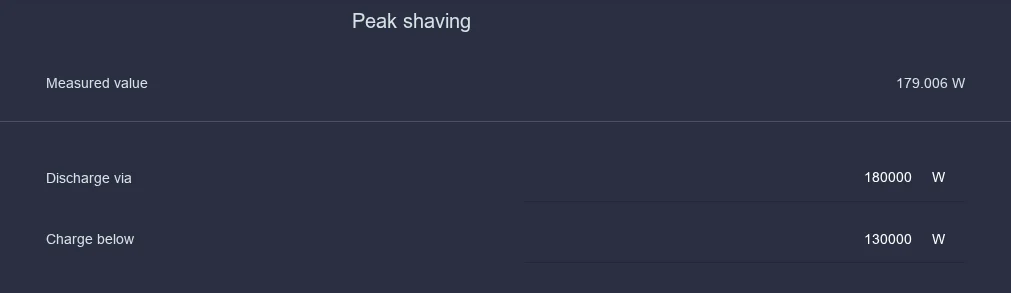
Open peak shaving and then its settings.
Enter Discharge via and Charge below in watts, for example 180000 for 180 kW.
Click the round button with the tick that appears at the bottom.
Look at the history to see when your peaks occurred so far and how high they were. Set Discharge via a little below the previous peak. The lower the limit, the more the battery has to do. Once it is empty, it cannot absorb any further peak. If in doubt, ask your installer for advice.
The history
The history shows how well peak shaving has worked:
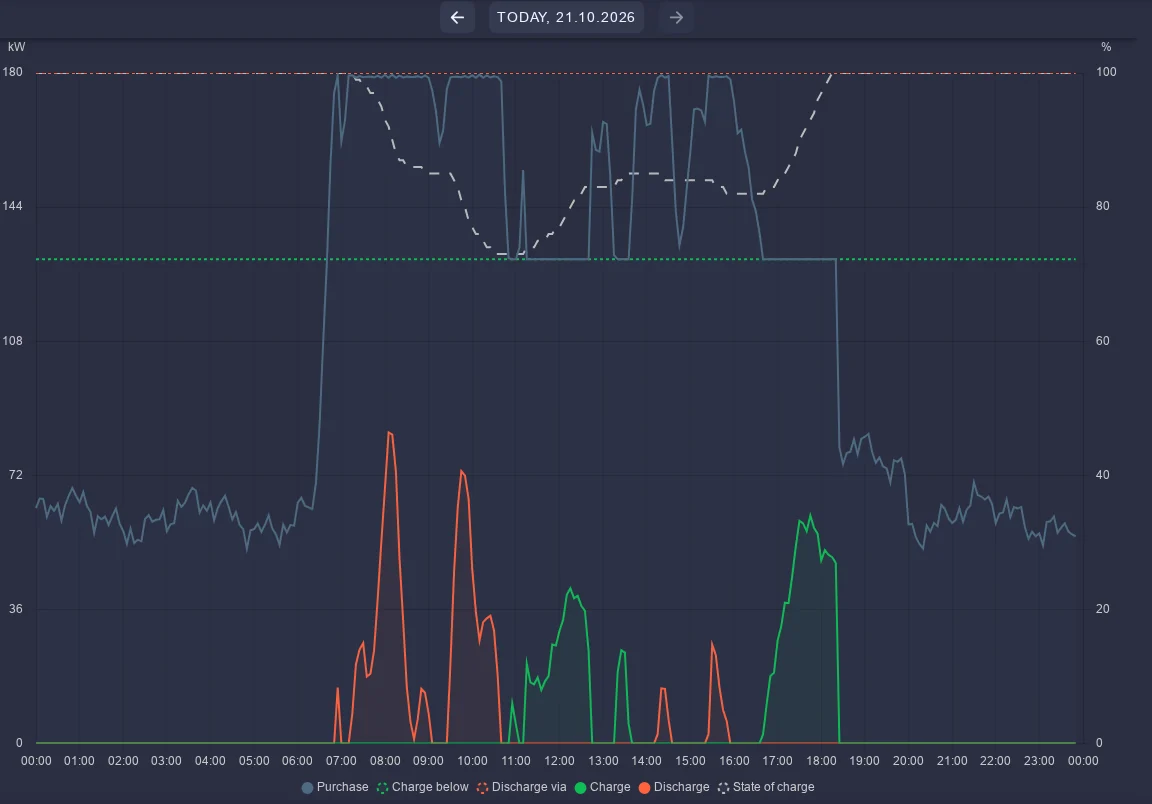
- Purchase is how much your business drew from the grid.
- Discharge via and Charge below are your two limits.
- Discharge and Charge show when the battery stepped in and when it recharged.
- State of charge shows how full the battery is.
In the example, the purchase rises to the upper limit from 7:00. The battery discharges and the grid purchase stays at the limit. Afterwards the battery recharges during the quieter period.
The variants
Peak shaving
The standard variant looks at the total purchase across all three phases. It suits most businesses.
Phase-accurate peak shaving
Here the limits apply per phase. Your SOLIO controls according to the phase that is currently most heavily loaded. This makes sense if your consumers load the three phases very unevenly, for example large single-phase machines. That way a single phase is not overloaded.
Time slot peak shaving
Here the battery only shaves peaks during a time window you set, for example on weekdays during production hours. Outside the time window your SOLIO recharges the battery so that it is ready for the next window.
In addition to the two limits, you set:
| Setting | Meaning |
|---|---|
| Weekdays (Mo to Su) | The days on which the time window applies. |
| Start date and End date | The period in which the rule applies. |
| Start time and End time | When the time window begins and ends on those days. |
| Loading capacity and Start time loading | From when and with how much power the battery is recharged outside the time window. |
| Threshold state of charge | The battery is charged fully and only recharged again once its state of charge falls below this value. |
Frequently asked questions
Why was the limit exceeded anyway? The battery can only absorb a peak as long as it has energy. If it is empty, or if the peak was larger than its power, the grid purchase rises above the limit. A higher limit or a larger battery helps.
Does this apply to private households too? Private households usually do not pay a demand charge. Peak shaving is therefore mainly intended for business and industry.